“Stripers are superb flats game fish and they’re readily available to many fly fishers. When striper stocks are up the opportunities are endless. When their numbers are down, sight-fishing is perhaps the most effective way of catching one on fly tackle.” – from Sight–Fishing for Striped Bass, July, 2001
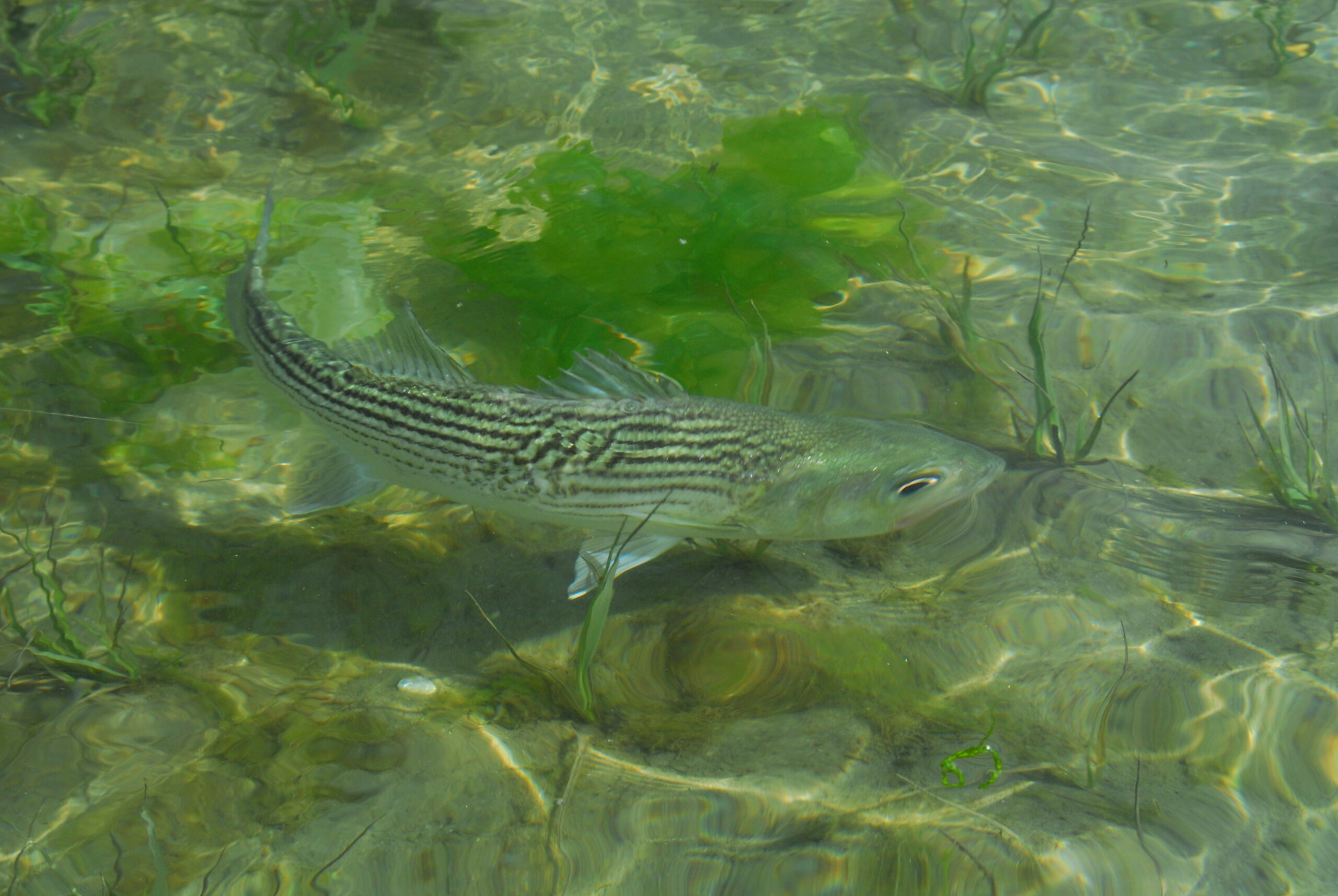
Prior to 1990 very few anglers knew that sight-casting to striped bass on clear shallow flats even existed. This challenging approach was considered quite difficult by virtually everyone in the very beginning, with early pioneers managing just a handful of flats catches in a season. 1993 to 2008 – the boom years for Atlantic striper populations – were packed with opportunity. With increasingly effective flies, ever-improving tackle and refined angling know-how, the “sight-fishery” advanced tremendously . . . and its popularity soared.
While today’s Atlantic striped bass numbers are again low, many fly fishers have discovered that sight-fishing remains an effective approach for catching them. The reason is simple – flats fishers visually hunt their quarry, while blind-casters typically work familiar spots with a repetitive cast-and-retrieve approach during low-light periods associated with sunrise and sunset (and throughout the night). They keep their flies in the water as often as possible and for as long as possible until eventually a fish spots their fly and takes it. It’s a statistical approach of sorts – when stripers are plentiful, they typically concentrate in prime feeding areas and the odds for catching them is quite favorable with a blind-casting approach. Experienced anglers know these feeding areas (and when they’re productive), which further stacks the deck in their favor. But today, blind-casters are vying to catch fish from a thinned-out herd that’s generally spread out and sometimes hard to find during much of the season. Sight-fishing, on the other hand, allows anglers to visually locate and stalk their quarry, which routinely produces fifteen or twenty reasonable opportunities over a three- or four-hour period on the flats. With the ability to make technically precise visual presentations, the odds of hooking up are quite good. The ability to visually hunt the fish and carefully present a fly to them makes all the difference . . . But this enhanced opportunity is not due to great numbers of fish embarking the flats to graze. For example, if an angler worked a flat with a random blind-casting approach, he or she would likely line many fish or otherwise spook them with bad retrieve angles (where the fly encroaches towards the fish instead of naturally fleeing away from it). Or the fly may just plop down too close and spook them. Skilled sight-fishers, on the other hand, can realistically convert these opportunities because the visual aspect of their approach stacks the deck in their favor.
The period of our season between the spring and fall migrations (typically mid-May through mid-September) has become known as the “sight-fishing season” – when stripers reliably embark the flats, spread out and graze the bottom for unique seasonal prey that’s also often spread out. Stalking the flats during these months has likely become the most productive approach with today’s diminished Atlantic striped bass stock. It’s unquestionably the most exciting. Despite great advances in fly pattern development, tackle and fishing equipment specifically developed for this fishery, sound strategies and proven on-the-water tactics remain most important for consistent success. No one bats 1.000 on the flats, but solid strategies, well executed tactics and constant attention to detail are trademarks of the .300 hitters in the game.
STRATEGY
The object of most fishing strategies is the same: to put you in fish as often as possible, for as long as possible, throughout the course of an outing. Anything is possible when fishing, but a sound strategy based on probability, rather than possibility, effectively stacks the deck in your favor.
Other than during spring spawning, stripers (like most fish) seek just two things: food and comfort/safety, and your strategy should always consider these two elements. Of the two, I sense that ample and attractive food sources are most important. Why? Well, simply embarking on a clear shallow flat in broad daylight is itself pretty risky business, but they routinely compromise comfort and safety to forage in this way. Though many things may be considered when formulating a fishing approach, the most important are 1- identifying relevant prey, 2- being mindful of water temperature, and 3- fishing in the right water level.
The Right Food Sources
Try to determine the food sources available on a flat or beach that will attract stripers. Keen on-the-water observation is the key here. Without ample food sources, a flat will be of little interest to the fish, and it should be a little interest to you, too. Flats prey important to striped bass generally fall into three categories: baitfish, such as silversides and sand eels; crabs, including green crabs, lady crabs and mole crabs; and either of two prolific shrimp species, sand shrimp and grass shrimp.
Baitfish are detected by carefully scanning the shallows with polarized glasses. They’re typically spread about and not always obvious, so you must look very closely for them. Bird feeding activity, particularly cormorants and diving terns, are a sure sign. These birds often disclose sand eels in the spring and silversides later, during the summer and early fall.
Healthy crab populations are readily detected through observation of remnant shells left along marsh banks, nestled in the spartina or other marsh grasses, or scattered along the high tide lines of fertile beaches and estuary shorelines.
Northern shrimp species are virtually invisible to the naked eye – they’re just inches long and translucent. Most flats contain shrimp, but to be sure, dragging a fine-mesh net over the sand bottom will quickly reveal them. If you wade barefoot, you’ll immediately detect them subtlety dashing from under your toes or darting into your ankles. For shrimp to be a viable food source there must be many of them, and preferably concentrated, so they should appear right away and in good numbers (six or more) with a single net-drag.
Water Temperature
Water temps in the 60’s F are ideal for striped bass flats fishing. Below 60F there is little prey activity to interest the bass. At 70F and above, the water becomes a bit warm for striped bass’ cold-blooded metabolism. Early in the sight-fishing season this is rarely an issue, as the fish appear on the flats as water in the shallows and along beaches hits the 60F mark. But as the season progresses, our nearshore waters warm quickly with long days and intensifying solar radiation (peaking on the summer solstice, but the warming continues into early September). Late in the season, as shallow nearshore waters near 70F, you must adjust your daily angling strategy to keep you in the action.
Dodging warm water can be tricky, but here are some clever work-arounds I’ve discovered over the years. First, fish early in the day when nearshore waters have cooled as much as five degrees (sometimes more) due to overnight radiational cooling. This cooling effect becomes significant with clear overnight skies, but is marginal with overcast conditions.
Second, if you’re fishing protected estuaries, lagoons, bays, etc., focus on the waters closest to the inlet that connects them to the sea – these waters remain cooler throughout the season than those further inside the estuary, and they’re effectively cooled by the influx of ocean water during every incoming tide. The incoming tide alone can magically bring the flats to life during the late summer doldrums simply by cooling the waters just a few degrees.
The waters adjacent ocean beaches can become excessively warm in late summer, as well, effectively shutting down the action despite being in direct contact with the sea. Here, an offshore breeze works wonders by blowing warm surface water away from the shoreline which in turn draws cooler bottom water into the shoreline surf. I always keep an eye on the marine forecast to take advantage of this phenomenon.
Water Level
Water level is critical when sight-fishing. Over the years I have found that knee-deep waters and above are actively prowled by fish, while waters below the knee are not. This is quite unlike bonefishing where just six inches of water is plenty of depth even for three-pound bones. There are, of course, no absolutes and stripers do at times go really shallow, but my strategy based on probability keeps me fishing in water at least knee-deep.
Certainly, anglers must account for the tide and fish closer or further from the water’s edge to adjust for rising or falling water levels. At times on certain flats this may put you ashore, fishing from a marsh bank. Other times you may have to wade out considerably to reach this water depth. Either way, anglers should be mindful of this and continuously adjust to focus their effort productively.
Anglers can certainly fish water that’s too deep, too. In fact, this is likely the most common error made by newcomers to the sport. While striper activity declines in water less than knee-deep, they may well be feeding in three, four or five feet of water if there is food present. Here’s the catch – with water above roughly mid-thigh for wading anglers, your eyes are simply too close to the water surface for your vision to be effective at seeing through the surface for well camouflaged fish. You may encounter plenty of fish in deeper reaches of the flat, but you’ll have no reasonable shot at them (you’ll be “stepping on them” as the saying goes). This issue can plague skiff anglers, as well, when attempting to target fish feeding on the bottom in five or six feet of water. A sound strategy keeps wading anglers in fish and able to make effective presentations in water from knee-deep to mid-thigh in depth, and skiff anglers in water from 18 inches to no more than four feet deep.
TACTICS
Coupled with a well-formulated strategy that maximizes striped bass encounters, proven on-the-water tactics enable you to capitalize on those opportunities. The two most relevant skills are: 1- maintaining your stealth, and 2- interpreting fish behavior.
Maintaining Your Stealth
It may seem impossible to conceal yourself while stalking fish on wide-open flats without cover, but distinct tactics enable anglers to remain undetected long enough to enable successful presentations that convert the opportunities created with a sound strategy. A smart strategy becomes useless when it’s undermined by poor stealth that spooks the fish before you ever have a chance to convert the opportunities it creates.
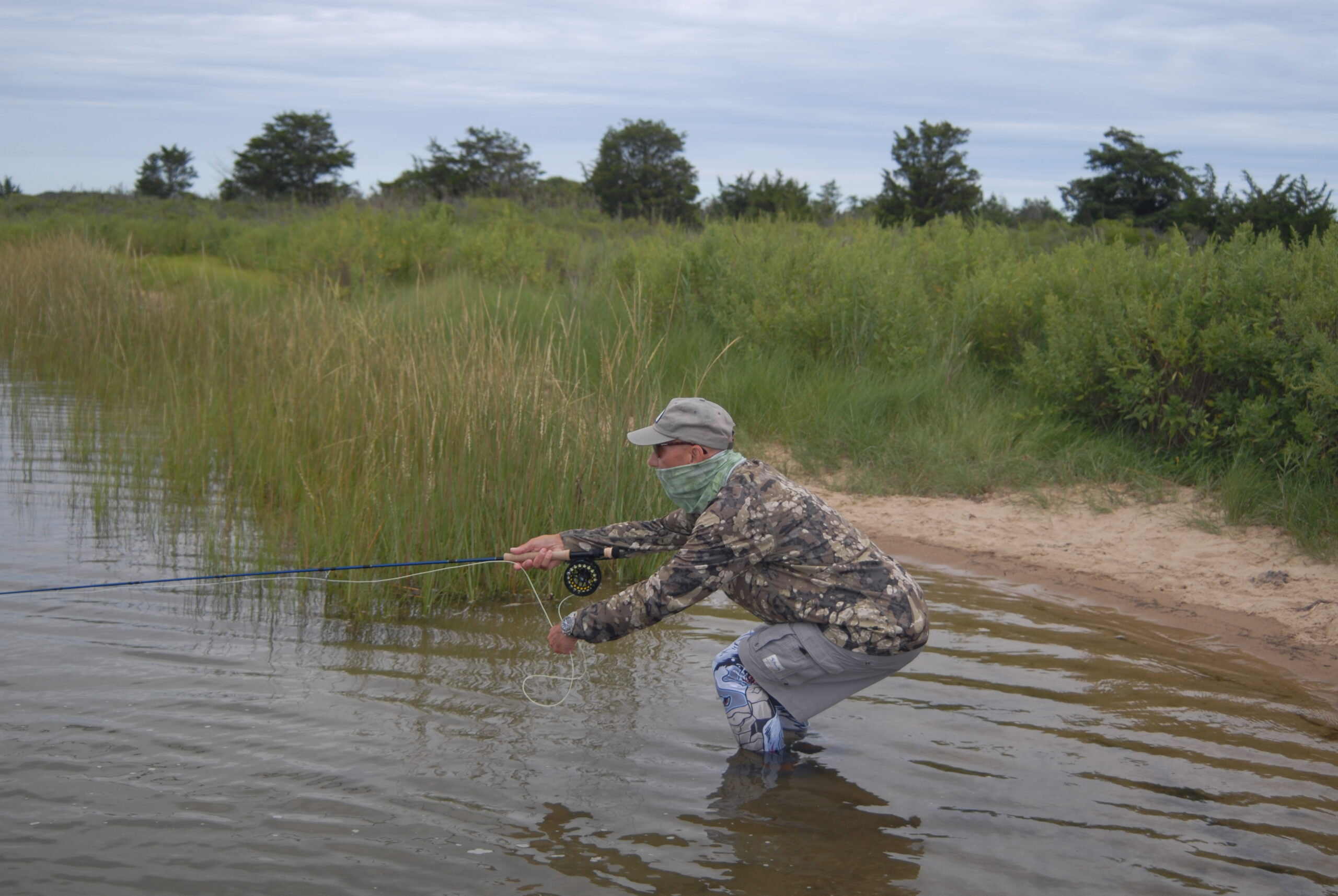
The fish can visually detect objects and motion above the water surface, and the higher above the surface it is, the further off the fish can detect it. Therefore, it is wise to keep a low profile any time the fish are near. Anglers acquire a sixth sense over time and know when it’s time to bend forward at the waist, or squat low to avoid detection. As a rule of thumb, when the fish are swimming toward me, I assume a low posture when they’re at 40 feet or less. Wearing dull, drab attire, as opposed to bright summer colors helps you blend with the sky and shoreline backdrops (hats are most relevant – I like tan or olive lids for sight-fishing). The elimination of shiny gadgets, such as forceps, Go-Pros, etc. greatly enhances your stealth – stripers pick up shine a long way off and it appears completely unnatural to them.
Stripers can also detect motion above the water quite well. I carry my rod low by my side and avoid flailing it overhead for any reason (which also causes rod-flash that can alert stripers of your presence while they’re still well out of spotting range) other than presentation casts that are made quickly with a minimum of false casting.
When wading, or poling in a skiff, strive to remain as quiet as possible. The general sight-fishing approach is to progress with the current in order to intercept fish that are often advancing into it, which makes it easy to avoid sloshing that may alert the fish. But the fish occasionally drift and feed with the current, or at times the sun angle does not favor down-current progression, both instances drive anglers to look up-current for target fish. In either of these cases, I prefer to post-up and fish from a stationary position– it’s a silent approach and you should reposition as often as necessary to stay in the action.
Reading Striper Behavior
Perhaps the most fascinating element of sight-fishing for striped bass is that multiple prey forms are often available simultaneously on a flat. Really fertile flats can harbor a half dozen different prey items all season long. But stripers – like trout – are rarely opportunists that pounce on just any prey that crosses their path . . . they are selective. This adds a great dimension to the striper game that’s often missing in other flats fishing venues. Careful observation and deciphering of bass feeding behavior is integral to fly selection, presentation, and consistent success (remember – our goal is to be a .300 hitter). Reading striper behavior should become part of your daily routine on the flats . . .
Fast-moving stripers, particularly fish high in the water column from mid-depth to near the surface are usually pursuing baitfish. This is especially true when they’re advancing into the current. Don’t expect bait showers, as with a fall blitz. Instead, striped bass during sight-fishing season chase down individual baitfish that oftentimes greyhound to escape a bass in hot pursuit. (NOTE – pods or groups of fish moving fast near the surface may likely still be in migratory mode and may be very difficult to feed, especially when encountered in springtime).
Fish observed moving low and slow in the water, very near the bottom, are likely hunting crabs. Within estuaries, stripers pursuing green and blue crabs may become preoccupied with grass patches, undercut banks and marsh edges; along ocean beaches crab hunters focus on sandbar formations when lady crabs are on the menu, and right on the water’s edge when gobbling up mole crabs unearthed by the wave action along the shoreline.
During the weeks surrounding the summer solstice (mid-June to mid-July), tailing fish present exciting opportunity. While stripers do not tail as often nor do they remain in that posture as long as bonefish do, the experience is just as exciting and calls for the same close and delicate presentation approach. These tipped-down fish are most often grubbing shrimp right out of the bottom, which is evident by the puffs of sediment they stir up. When a group of fish descends on a thick patch of shrimp, they’ll often generate a “mud”, again, very similar to a school of bonefish.
Occasionally I encounter fish, either singles or in small groups (or pods), that are moving about quickly and erratically. Oftentimes, you’ll notice one or more of them “flashing” – rolling momentarily on their side and then quickly turning upright again, which radiates a starkly visible flash in the sunlight. Over the years I have found these fish very difficult to entice – they’re spooked and unwilling to eat. Whether I was sloppy with my stealth or someone else in the vicinity alarmed them is irrelevant – I leave those fish alone to cool off and go find more willing participants.
TIPS ON FLY SELECTION
On the flats, small baitfish are best imitated with sparse patterns such as Bendbacks, Deceivers, Clouser Minnows, and Half ‘n Halfs in neutral tones that are light on flash and suit the length of local spearing or sand eels. Striped bass encounters often occur suddenly with the target fish first appearing already well within casting range, oftentimes at a difficult casting angle (stripers are masters of surprise). The quick casting response (roll-out, backcast and forward cast delivery) required to convert these short encounters may be awkward and can easily result in delivering a fouled fly if the pattern is too long, soft and “slinky”. Longer presentations call for longer casts, but they, too, can lead to a similar result, especially with inexperienced casters or when the wind is up. Missed opportunities are especially frustrating with today’s lean striper fishery. I avert this issue by fishing Bendbacks (a foul-proof pattern by design) or foul-resistant Deceivers, Half ‘n Halfs and Clouser Minnows.
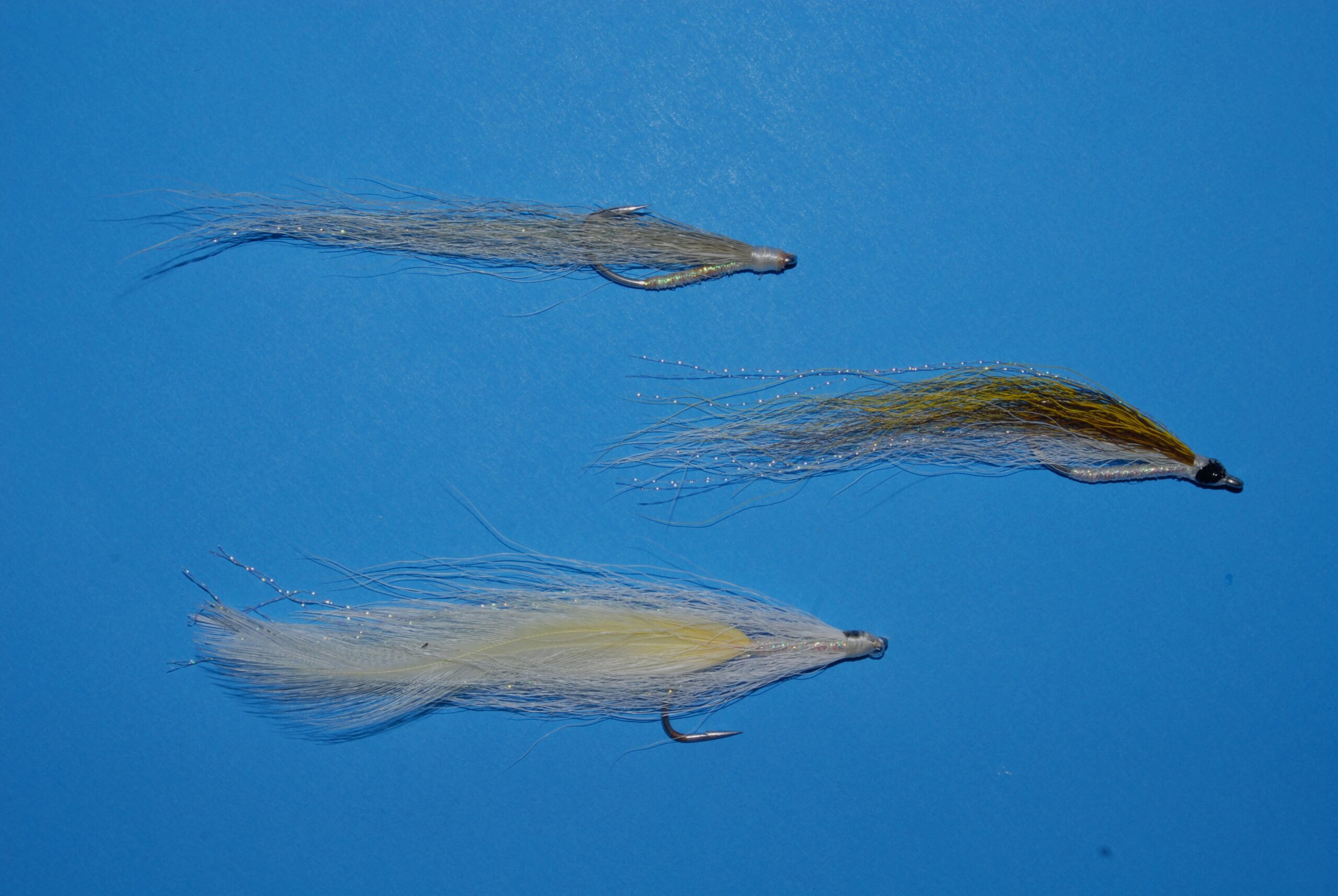
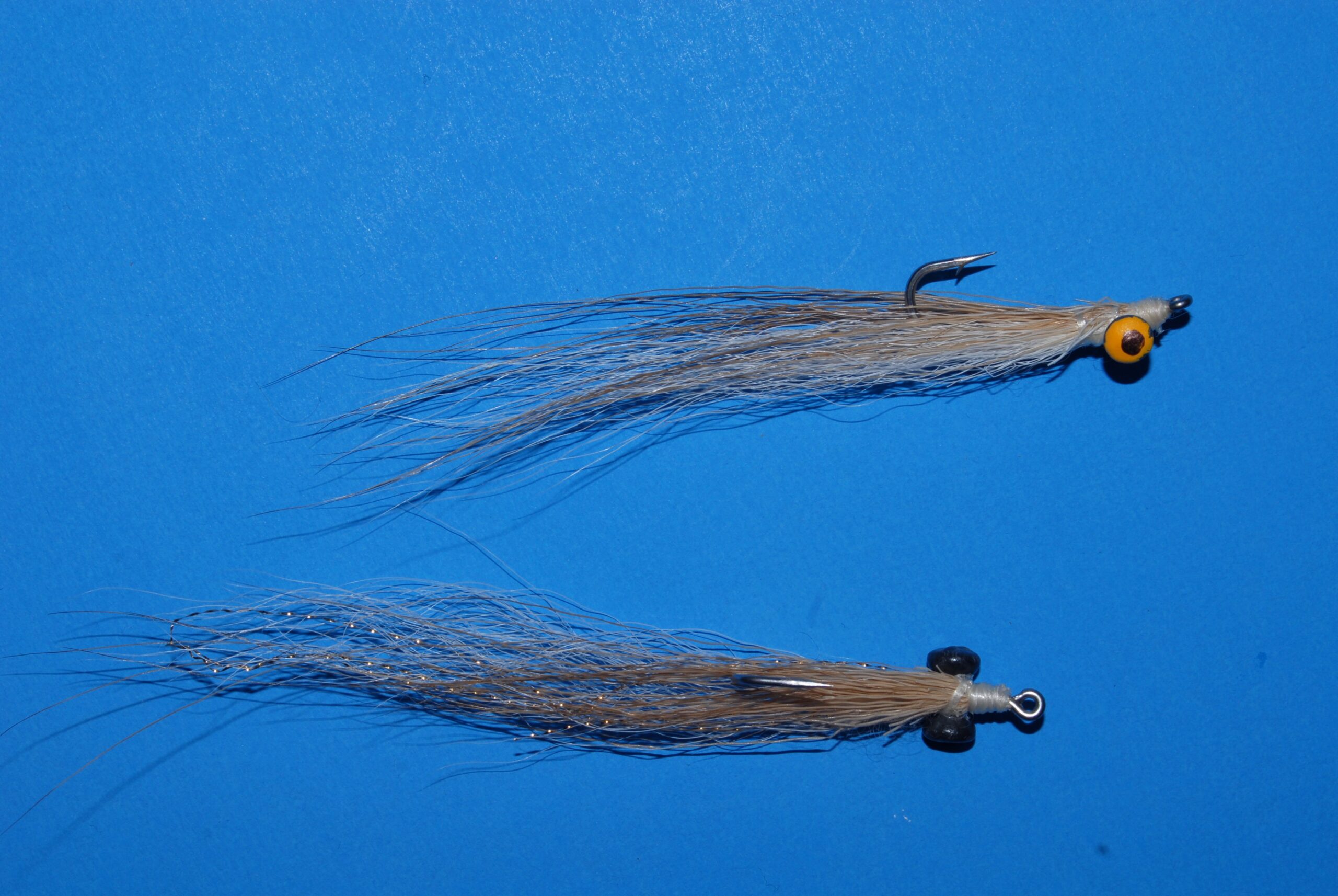
I emphasize minimal flash (if any at all), as loud, flashy flies can spook bass in bright, clear flats conditions. I also favor small, very sharp, dull-finish hooks in sizes 2 and 4 for 90% of my flats flies. Daiichi 2546 and Tiemco 811 hooks possess these attributes and are excellent choices for striper flats fishing (and for most bonefishing, too).
For imitating crabs in estuaries or bays I favor appropriately weighted green crab imitations, such as the Green Diablo. Along ocean beaches and other open water sand flats, heavily weighted mole and lady crab imitations – Dave Skok’s Mole Crab, the Beach Bug, and the Flying Monkey (a swimming crab imitation) are proven winners. Please refer to the FLY PATTERNS section of this website.
Tailing and mudding fish call for lightly weighted shrimp imitations. Classic bonefish patterns, such as small, sparse Clouser Minnows with a bit of Krystal Flash, or Gotchas in sizes 4 and 6 are reliable choices. Groups of mudding fish are easily taken with a fly-drop anywhere within the mud (with the up-tide edge of the mud being the prime drop spot). Tailing stripers, on the other hand, often demand pinpoint fly placement with close proximity to the fish’s head. Specialty fly designs, such as the Tailing Striper Fly (please see the FLY PATTERNS section of this website), land softly, enabling the very close fly-drops often required to take these fish. Lightly weighted Gotchas are also effective for tipped-down or tailing striped bass.
